
Why we are not building a generic chatbot
We’re building more than just “ChatGPT inside CAD.” By turning CAD into AAD (AI-Aided Design), we aim to create agents that makes you feel it is living INSIDE CAD workflows, not a tool that sits next to it.
Today’s AI x CAD products tend to fall into four forms:
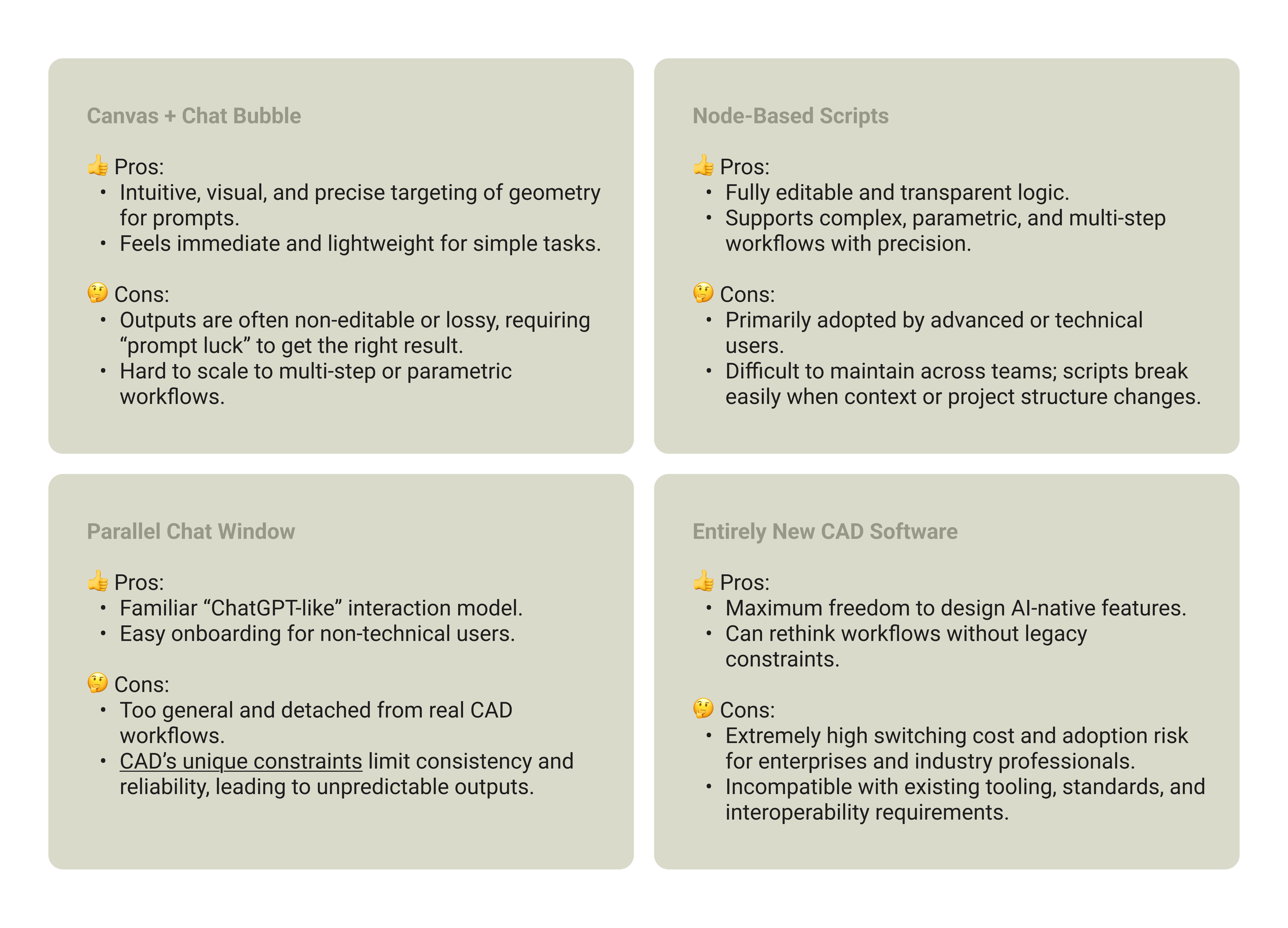
What’s missing is a tool that lives within users’ workflow, allowing users to accomplish more with less. Here's a sneak peek into what we learned and what we are building towards:
Human Communication as the Blueprint for AI Collaboration
Seeing how users interact with different CAD MCPs -- and even with our own early MVP as a typical “CAD co-pilot” -- we realized that the bar for truly "vibe CADing" is still extremely high. The challenge isn’t that users are unwilling to write detailed prompts; it’s that CAD is fundamentally spatial. When a designer wants to tell AI to “put this over there,” it can take an unreasonable amount of effort to specify what “this” is and where “there” should be.
At first, we assumed this was simply a communication skill that people could adapt to over time. We even launched a series called Reer Academy, sharing best practices on prompting for precise 3D manipulation. But as we experimented more with real users, it became clear that a standalone AI assistant -- no matter how powerful -- just isn’t the most intuitive way to enter an established professional workflow. It often feels omnipotent yet vague, ambitious yet over-promising.
So we shifted focus. We studied how humans communicate with each other when collaborating on CAD tasks, and building experiences that mirrors those patterns. Instead of a universal chatbot, we are building towards a system that appears as an ambient, purpose-built helper woven directly into each workflow -- feeling natural, contextual, and often offering help before user even realize they need it.
From Muscle Memory to Machine Intelligence
Since our goal is to automate the repetitive, often tedious grunt work in professional CAD, we’ve centered our research on understanding how experts actually work -- their muscle memory, favorite shortcuts, navigation habits, and the micro-actions they repeat dozens of times a day. While many AI tools start from the macro workflow level, we’ve found that it’s often the micro-scale behaviors, the small, incremental steps people hardly notice, when observed across many workflows, reveal surprisingly consistent patterns. And once you can connect those patterns across tasks, tools, and contexts, you start to see exactly where repetition and cognitive load accumulate.
Those moments are not only pain points - they’re clear signals for where AI can step in naturally, predict what the user is trying to do, and remove friction without disrupting flow.
This led us to a core philosophy for Reer’s UX/AX design: build AI agents that feel alive inside CAD -- aware of context, sensitive to intent, and quietly supportive -- yet never intrusive or overbearing. AII in service of our mission to transform CAD into AAD.
Creating Incremental “Quality of Life” Magic
From our user testing, the strongest whoa moments don’t actually come from big, zero-to-one generative feats, like when the AI agent builds a full floor slab based on a prompt. Instead, they happen in the smaller, smarter moments: when a user changes a floor height and Reer automatically extends dozens of columns to reach the new ceiling heights accordingly. These micro-interactions feel intelligent, anticipatory, and aligned with how people actually work.
As we collect more of these reactions, we’ve realized something fundamental: expectation management is everything. Two users can have the AI complete the exact same task, yet feel vastly different levels of satisfaction depending on whether the AI’s behavior aligns with their mental model.
Many of our business users initially worry about the learning curve cost and about whether AI tools lack the domain depth required for professional-grade workflows. But when we ask them to compare onboarding a new team member with onboarding Reer, the hesitation dissolves. They immediately understand the parallel and become far more open to adopting the tool. Just like working with a standout teammate, the moment we are impressed by a person’s ability is when they are actively thinking one step further, understanding the essence of the problem, and acting proactively instead of passively waiting to be instructed. And this is what a generic chatbot cannot achieve.

Reer is Not a Chatbot, but an Input Engine.
Reer isn’t built to chat -- it’s built to understand and act. While others translate words into words, Reer translates intention into CAD actions, reading the story designers tell through clicks, selections, and the subtle choreography of modeling.
CAD has always been a spatial language -- quiet, precise, deeply contextual. So we built an agent that listens not just to text, but to everything: actions, habits, micro-movements, and the invisible rhythm of creation.
Because every gesture is intention.
Every intention is a signal.
And every signal deserves action, not conversation.
This is the future of AAD.
And we’re just getting started...